
From Travel Sale to Payment: How Travel Agencies Can Manage Every Sales Step
For a travel agency, a sale does not end when a customer chooses a tour, flight, hotel, or another travel service. In reality, that is only the beginning of a longer operational and financial process.
A single travel sale can involve customer information, service details, supplier costs, commissions, advance payments, remaining balances, invoices, contracts, refunds, and other financial transactions. When these steps are managed separately, even a successful sale can create additional administrative work for the agency.
As the number of customers and sales grows, keeping track of every transaction manually becomes increasingly difficult. Sales teams need to know what has been sold, finance teams need to know what has been paid, and management needs a clear picture of revenue, receivables, supplier obligations, and profitability.
This is where a structured travel agency sales management process becomes important.
With Travacco, travel agencies can manage the journey from creating a sale to recording payments and completing the related financial operations within one connected system.
Travel Agency Sales Is More Than Closing a Sale
A typical travel sale can look simple from the customer's perspective.
A customer contacts the agency, selects a service, confirms the booking, and makes a payment. However, behind that transaction, the agency may need to complete several additional steps.
For example, a customer purchasing a tour package may require:
- Customer registration and profile management
- Tour or service selection
- Supplier information
- Sales price and purchase cost
- Commission calculation
- Customer payment
- Advance payment tracking
- Remaining balance
- Contract and invoice preparation
- Supplier payment
- Refund management if the booking changes
- Profitability tracking
If these details are stored in different files, spreadsheets, messages, or accounting records, it becomes harder to maintain accurate information.
A travel agency needs a sales process where these operations remain connected.
1. Start With a Structured Sale
The first step is creating the sale itself.
Travel agencies handle different types of products and services. A customer may purchase a flight ticket, hotel, tour package, transportation service, or several services together.
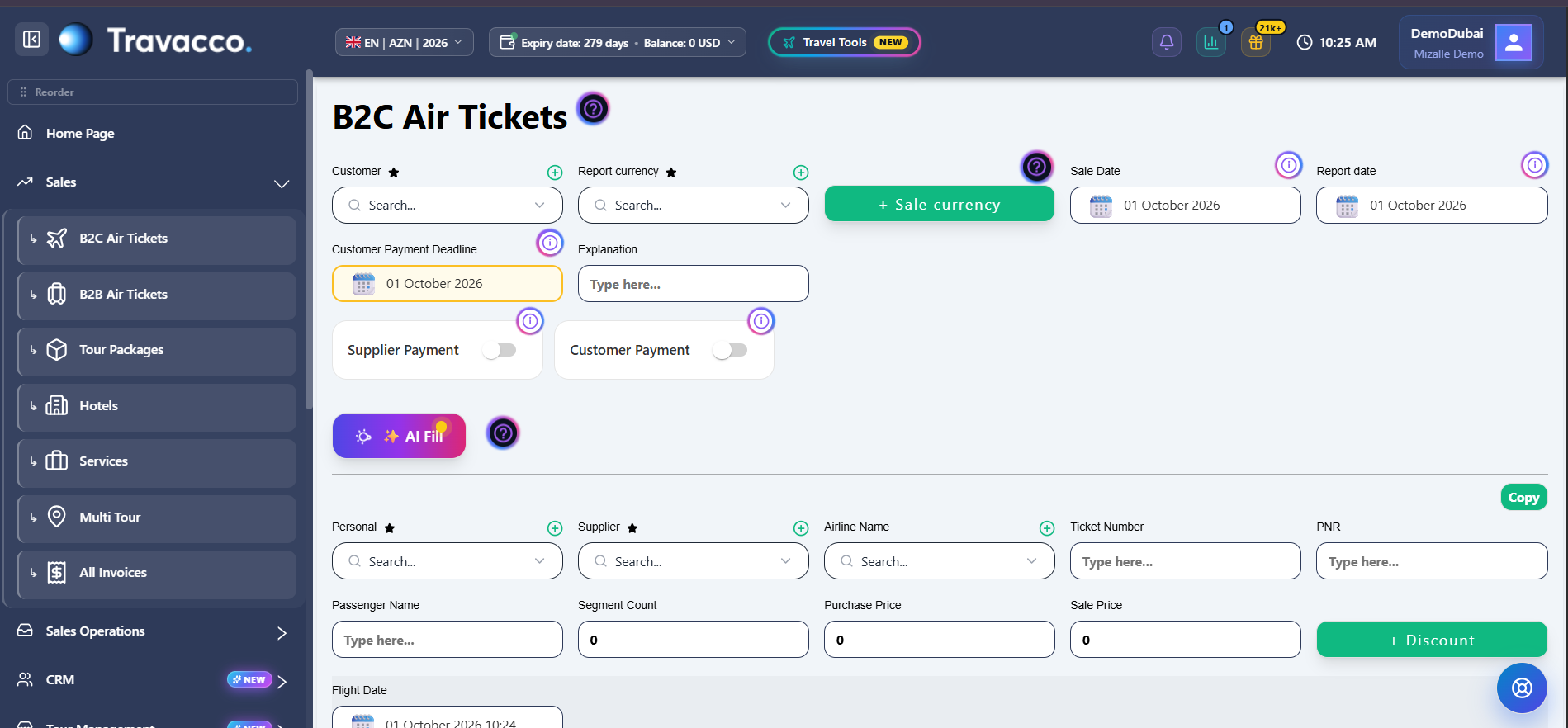
Travacco's Sales functionality is designed around these different travel sales scenarios. Agencies can create sales and organize the relevant customer, service, pricing, and payment information within the system.
This creates a central record for each transaction instead of requiring employees to maintain separate notes for different parts of the sale.
For agencies working with both individual travelers and business partners, having organized sales records is particularly important. B2C and B2B transactions may have different pricing, payment, and supplier conditions, making centralized sales information valuable for daily operations.
2. Keep Customer Payments Under Control
Creating a sale is only one part of the financial process.
Customers may pay the full amount immediately, or they may make an advance payment and complete the remaining balance later. Without a dedicated system, employees may need to manually calculate what has been paid and what is still outstanding.
Travacco allows travel agencies to record customer income and advance payments as part of the sales process.
Instead of simply seeing that a sale exists, the agency can follow its financial status as well.
This makes it easier to answer questions such as:
- How much has the customer already paid?
- Is there an outstanding balance?
- Was an advance payment received?
- Which sales still require payment?
- What amount should be collected from the customer?
For sales teams, this means less time spent checking separate payment records. For management, it provides a clearer view of the agency's receivables.
3. Manage Supplier Payments Alongside Sales
A travel agency does not only receive money from customers. It also has financial obligations toward airlines, hotels, tour suppliers, transportation providers, and other partners.
This creates two sides of the same transaction:
Customer payment → Agency revenue
Supplier payment → Agency cost
Looking at only one side can give an incomplete picture of the actual financial position of a sale.
Travacco connects sales information with supplier-related financial operations, helping agencies follow how much has been received from the customer and what needs to be paid to the relevant partner.
This is particularly useful when a sale includes commissions or different purchase and selling prices.
For example, if a travel agency sells a service for $1,500 and the supplier cost is $1,200, the agency needs to understand not only the $1,500 customer payment but also the $1,200 supplier obligation.
Having these figures connected makes it easier to understand the financial result of the transaction.
4. Turn Sales Data Into Documents
Travel sales often require more than an internal transaction record.
Depending on the sale, the agency may need to prepare contracts, invoices, vouchers, or other customer-facing documents.
When these documents have to be created manually after every sale, employees spend additional time copying information from one place to another. This also creates the possibility of inconsistencies between the original sale and the final document.
Travacco helps connect the sales process with document generation.
Once the relevant sale is approved, the information can be used for related customer and financial processes. This reduces unnecessary repetition and helps keep sales information consistent throughout the workflow.
For a growing travel agency, this type of automation can make a significant difference because the time saved on individual transactions becomes much more valuable as the number of sales increases.
5. Handle Refunds as Part of the Sales Process
Not every travel sale follows the original plan.
A customer may cancel a booking, change a service, request a refund, or receive only part of the original payment back. These situations need to be reflected in the agency's financial records.
A refund should not be treated as an isolated action. It affects the original sale, customer balance, and the agency's financial results.
Travacco includes refund management within its Sales Operations functionality, allowing agencies to record refund transactions and maintain a clearer connection between the original sale and the subsequent financial activity.
This is especially important for travel agencies because cancellations and booking changes can occur across flights, hotels, tours, and other services.
6. Keep Contracts, Invoices and Payments Connected
Another challenge for travel agencies is keeping documents and financial transactions aligned.
Imagine an employee creates a sale, another employee records the payment, and a third person prepares the invoice. If these processes are managed independently, everyone needs to verify the information again.
A connected system reduces this repetition.
Within Travacco, sales information can flow into related operations such as customer income, contracts, invoices, and refunds. This gives the agency a more structured way to manage the financial lifecycle of a sale.
The objective is not simply to digitize individual tasks. It is to connect them so that employees can work with the same underlying information.
7. Understand the Financial Result of Every Sale
Revenue alone does not tell a travel agency how successful a sale is.
A $2,000 sale may look attractive, but if the supplier cost is $1,850, the financial result is very different from a $2,000 sale with a $1,300 supplier cost.
For this reason, travel agencies need visibility into both revenue and costs.
Travacco helps agencies follow customer payments, supplier-related amounts, and other financial operations associated with sales. This creates a stronger foundation for understanding profitability.
Instead of asking only:
"How much did we sell?"
management can also look at questions such as:
"How much have we collected?"
"How much do we owe our partners?"
"What remains to be collected?"
"What is the financial result of the sale?"
This level of visibility becomes increasingly important as an agency handles more transactions.
8. Manage Different Sales Models in One System
Travel agencies rarely sell only one type of product.
One employee may create a flight sale, another may handle a hotel reservation, while another works on a complete tour package. Business clients may also have different payment and pricing arrangements.
Travacco is designed to support different travel sales scenarios within the same environment.
Sales can include categories such as:
- B2C
- B2B
- Tour Packages
- Hotels
- Services
- Multi-Tour
This allows agencies to organize different types of sales without creating completely separate workflows for each product.
The advantage is particularly visible for agencies that manage multiple services for the same customer. Instead of treating every transaction as an unrelated record, the agency can maintain a broader view of the customer's travel-related activity.
9. Move From Manual Tracking to Connected Sales Operations
Spreadsheets and manual records may work when a business is small and the number of transactions is limited.
But as the agency grows, the same methods can create operational bottlenecks.
Employees may spend time searching for payment records, checking outstanding balances, preparing documents, confirming supplier payments, or reconciling information between different systems.
A connected sales management solution changes the workflow.
With Travacco, the sales process and related financial operations are managed within one business solution created specifically for travel agencies.
This means sales teams can focus more on customers and selling, while the system provides a structured environment for the operational and financial steps that follow each transaction.
10. What Happens After the Sale?
A modern travel agency should not think of a sale as a single event.
The real sales lifecycle continues after the customer says yes.
The agency still needs to:
Create the sale → Record payments → Track balances → Manage supplier obligations → Prepare documents → Process refunds when needed → Monitor profitability
When these stages are connected, the agency gains more control over its operations.
Travacco brings these processes together so that travel agencies can manage sales from creation through their related financial operations without relying on disconnected workflows.
This also creates a stronger foundation for other areas of the business. Customer information can remain connected with the sale, while approved transactions can update the relevant customer records and contribute to a broader view of the agency's financial activity.
Why Connected Sales Management Matters for Travel Agencies
The biggest challenge is not necessarily the number of sales an agency makes. It is the number of steps associated with every sale.
One transaction can generate multiple actions, documents, payments, and financial records. When these are handled manually, the workload grows together with sales volume.
A connected sales system allows agencies to standardize these processes.
It can help reduce repetitive data entry, provide clearer payment information, keep customer and financial records connected, and give management a more transparent view of sales performance.
For a travel agency, this means the sales process becomes more than simply recording transactions. It becomes a structured operational workflow.
Travacco: From Sale Creation to Financial Management
Travacco brings travel agency sales and related financial operations together in one system.
From creating B2C and B2B sales to managing customer income, advance payments, supplier payments, contracts, invoices, and refunds, the platform helps agencies follow the complete sales lifecycle.
The benefit is not simply having another tool for creating sales. The real value comes from connecting the steps that happen before, during, and after the sale.
When sales information, customer data, documents, and financial operations work together, travel agencies can spend less time managing fragmented processes and more time focusing on their customers and business growth.
For travel agencies, a completed sale is not the end of the process. It is the starting point for a series of operational and financial activities.
Customer payments need to be tracked. Supplier obligations need to be managed. Contracts and invoices need to be prepared. Refunds need to be recorded correctly. And ultimately, the agency needs to understand the financial result of every transaction.
Managing these steps separately can make sales operations unnecessarily complicated.
A connected solution such as Travacco allows travel agencies to bring these processes together from the initial sale to payment and the financial operations that follow.
When every sales step is connected, the agency gets a clearer picture of its transactions, finances, customers, and overall business activity.
From the first sale to the final payment, every step matters. Travacco helps travel agencies manage them in one connected system.