
Travel Agency Profitability: Know Where Your Money Actually Goes
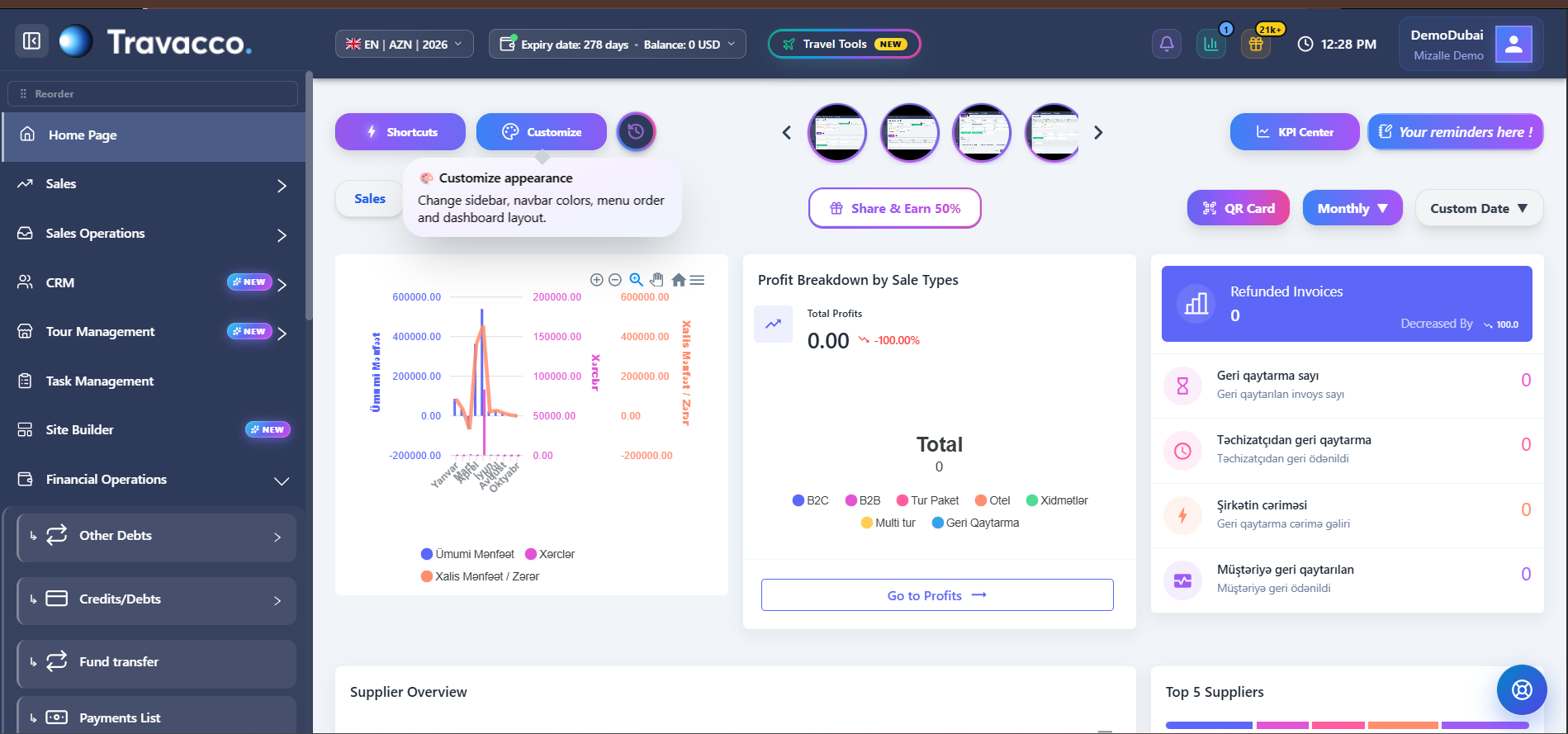
A travel agency can generate strong sales and still struggle to understand how profitable its business actually is.
At first glance, the calculation seems simple: sell a tour for $2,000, pay the supplier $1,500, and the agency has made $500. In practice, however, travel agency finances rarely work that simply. Customer payments may arrive in installments, supplier payments may have different deadlines, refunds may change the final amount, and additional services can affect the total cost of a booking.
This is why travel agency profitability should not be measured only by looking at total sales.
To understand the real financial position of a travel agency, businesses need to see the complete picture: how much was sold, how much customers have paid, how much is still outstanding, what has been paid to suppliers, what has been refunded, and what remains as actual revenue or profit.
Sales Revenue Is Not the Same as Profit
One of the most common mistakes in travel business management is treating sales revenue as profit.
Imagine that an agency sells a holiday package for $3,500. That number may look impressive on a monthly sales report. But the agency may need to pay $2,700 to suppliers, $200 for additional services, and process a $100 refund.
The amount remaining is very different from the original $3,500 sale.
This distinction becomes even more important when an agency manages dozens or hundreds of bookings simultaneously. Calculating profitability manually can quickly become difficult, especially when payments are recorded in different places.
A clear financial structure should answer several questions:
- How much has the agency sold?
- How much has the customer actually paid?
- How much does the customer still owe?
- How much does the agency owe suppliers?
- Which bookings have been refunded?
- What are the final financial results of each sale?
- How much profit is generated by individual tours, services, or bookings?
Without this information, an agency may know its sales volume without truly understanding its profitability.
Why Profitability Tracking Matters for Travel Agencies
Travel agencies deal with financial transactions that are more complicated than a simple product sale.
A single booking can include flights, accommodation, transfers, tours, insurance, visas, and other travel services. Each component can involve different suppliers, prices, currencies, payment schedules, and commissions.
For example, a customer may book a tour package that includes:
- International flights
- Hotel accommodation
- Airport transfers
- Travel insurance
- Excursions
The customer may pay the agency in advance, while the agency pays different suppliers according to separate schedules.
If these transactions are not connected, it becomes difficult to determine the financial result of the booking.
The agency may see that the customer has paid $4,000, but that does not automatically mean the agency has earned $4,000. Some of that amount may already be committed to suppliers.
This is where structured travel agency financial management becomes essential.
Understanding the Complete Financial Flow
A more accurate way to look at profitability is to follow the entire financial journey of a sale.
Sale → Customer Payment → Supplier Payment → Refunds and Adjustments → Financial Result
Each step affects the final picture.
1. Creating the Sale
Everything starts with the sale.
The agency records what the customer purchased, the selling price, relevant services, and the parties involved in the transaction.
At this stage, it is important to distinguish between the amount charged to the customer and the cost associated with delivering the service.
This creates the foundation for calculating the financial result later.
2. Tracking Customer Payments
A customer may not always pay the full amount at once.
For example, a $5,000 booking could be paid in three stages:
- $1,500 initial payment
- $1,500 second payment
- $2,000 final payment
The agency therefore needs to know not only the total sale value but also how much has actually been collected.
This helps the business identify outstanding customer balances and manage receivables more effectively.
3. Managing Supplier Payments
On the other side of the transaction, the agency may have obligations toward airlines, hotels, tour operators, transport providers, or other suppliers.
Suppose the agency has received $3,000 from a customer but still needs to pay $2,400 to suppliers.
The agency's cash position and its final profitability are therefore two different things.
Keeping supplier obligations visible helps the agency understand how much money is committed and what remains after those obligations are taken into account.
4. Recording Refunds
Travel plans change.
Flights can be cancelled, customers can modify bookings, and services can be partially or fully refunded.
A refund can directly change the financial result of a sale.
If refunds are managed separately from the original transaction, it becomes harder to understand what the booking ultimately generated.
A connected financial process allows these adjustments to remain part of the overall transaction history.
From Individual Sales to Business-Level Profitability
Tracking one booking is useful, but travel agencies also need to understand profitability across the entire business.
- Which tours generate the most revenue?
- Which services produce stronger margins?
- How much is tied up in outstanding customer payments?
- How much is payable to suppliers?
- How do refunds affect monthly results?
These questions become much harder to answer when financial information is scattered across spreadsheets, messages, documents, and separate systems.
A centralized system makes it possible to move from individual transaction management to a broader view of business performance.
This is particularly important for agencies offering multiple types of services. A business might sell tour packages, hotels, flights, transfers, insurance, and other travel products at the same time.
Each category can have a different cost structure and profitability level.
How Travacco Helps Travel Agencies Track Profitability
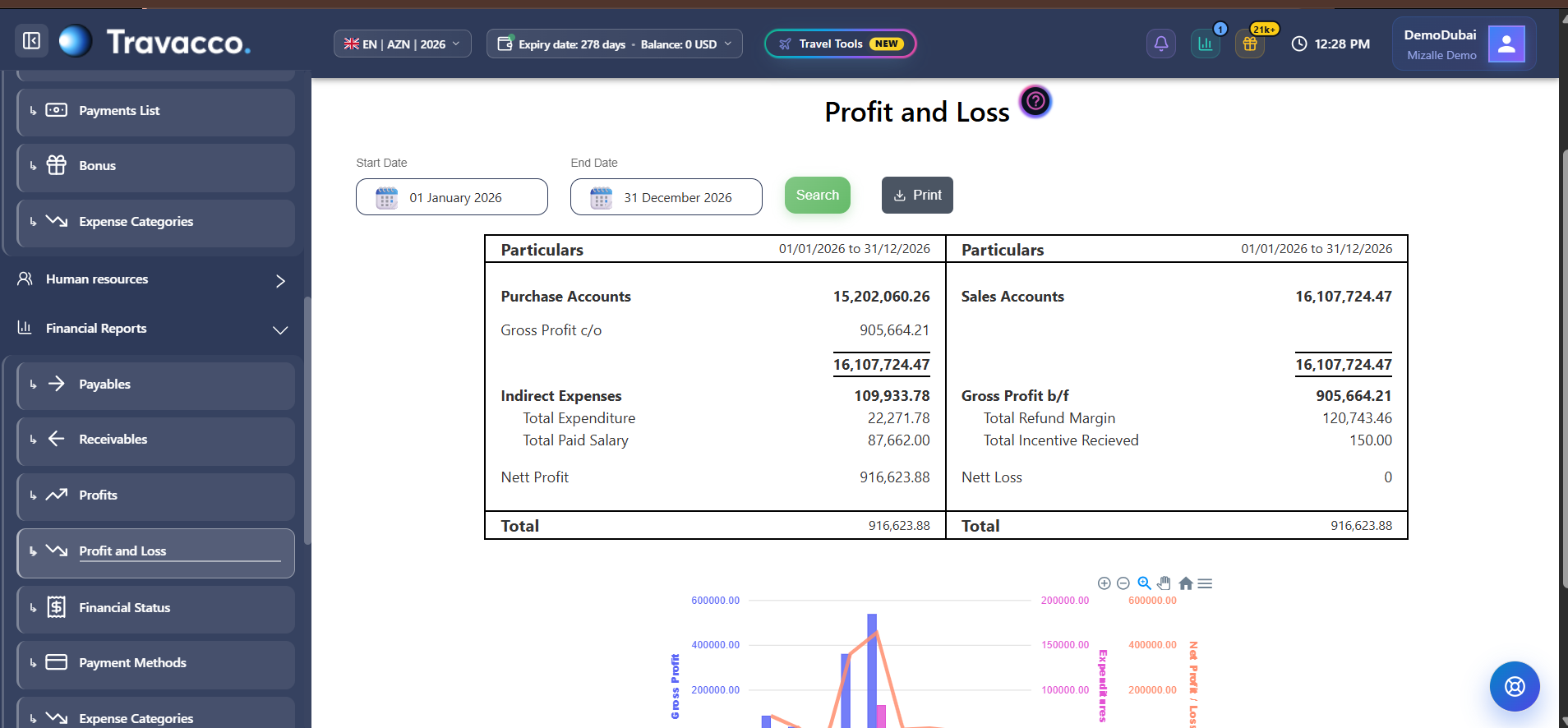
Travacco brings sales and financial processes together in a single system designed specifically for travel agencies.
Instead of treating a sale as an isolated transaction, the system connects the commercial and financial steps that follow it.
Travel agencies can manage processes such as customer income, supplier-related payments, invoices, advances, refunds, contracts, and other financial operations within the same environment.
This creates a clearer relationship between the original sale and the transactions that happen afterward.
For example, once a sale is created, the agency can continue managing the financial process without having to rebuild the same information in a separate system.
This is especially useful when a booking involves multiple payments or financial adjustments.
Seeing Customer Receivables More Clearly
Outstanding customer payments are an important part of travel agency cash flow.
A booking may be confirmed, but the customer may still have an unpaid balance.
Without a clear receivables process, employees may need to check individual records or rely on manual reminders to determine who still owes money.
A centralized system allows agencies to keep these balances visible and connected to the relevant customer and sale.
This makes it easier for teams to follow up on payments and understand how much revenue has actually been collected.
Keeping Supplier Obligations Under Control
The same principle applies to supplier payments.
An agency can have significant sales while also carrying substantial obligations to hotels, airlines, tour operators, and other partners.
Knowing how much the agency owes is just as important as knowing how much customers owe the agency.
When both sides are tracked systematically, management gets a more complete picture of the company's financial position.
Instead of looking at revenue from only one side, the agency can consider both receivables and payables when evaluating its financial operations.
Profitability Starts With Better Data
Accurate profitability analysis depends on accurate data.
If customer payments are missing, supplier obligations are incomplete, or refunds are recorded separately, the resulting financial reports may not represent the actual situation.
This is why financial management is not only about producing reports at the end of the month.
It starts with recording every relevant transaction correctly.
When sales, customers, payments, invoices, refunds, and supplier transactions are connected, the agency has a much stronger foundation for analyzing its performance.
Why Manual Profit Calculations Become Difficult
Spreadsheets can be useful for small teams, but as an agency grows, the number of transactions increases.
Consider an agency handling:
- 100+ customer bookings
- Multiple suppliers
- Several currencies
- Installment payments
- Frequent booking changes
- Refunds and cancellations
- Different travel products
Maintaining all of this information manually can create inconsistencies.
An employee may update a spreadsheet but forget to update another document. A refund may be recorded separately. A supplier payment may not be connected to the original booking.
Over time, these small gaps make it harder to understand the actual financial result.
The problem is not necessarily the amount of data. It is the lack of connection between the data.
A More Practical Approach to Travel Agency Profitability
Travel agencies do not need to look at profitability as a single number at the end of the month.
A more useful approach is to make profitability part of everyday operations.
Every sale should answer:
- What was sold?
- How much did the customer pay?
- How much remains to be collected?
- What does the agency need to pay suppliers?
- Were there any refunds or adjustments?
- What is the final financial result?
When these questions can be answered from the same system, financial decision-making becomes much more straightforward.
Profitability Is About More Than Selling More
Growing sales is important for any travel agency, but higher sales do not automatically mean higher profits.
An agency can increase its sales volume while also increasing its supplier costs, outstanding receivables, refunds, or operational expenses.
That is why sustainable growth requires visibility into what happens after the sale.
The objective is not simply to sell more travel products.
It is to understand which transactions create value, where money is going, what remains outstanding, and how the overall financial position is changing.
Turning Financial Data Into Better Business Decisions
Once an agency has reliable financial information, management can make more informed operational decisions.
For example, the agency can identify which types of travel products contribute significantly to revenue, monitor outstanding balances, review supplier obligations, and analyze the results of different sales activities.
This information can also help managers evaluate business performance over time.
Instead of asking only:
“How much did we sell this month?”
they can ask:
“What did those sales actually generate after the related financial transactions?”
That is a much more meaningful question for business management.
For travel agencies, profitability is not hidden in one report or one number.
It is spread across the entire financial lifecycle of every booking: the sale, customer payments, supplier payments, invoices, refunds, outstanding balances, and final results.
When these processes are managed separately, understanding profitability becomes more difficult. When they are connected, the agency gains a clearer view of where its money comes from, where it goes, and what remains.
Travacco helps travel agencies bring these processes together in one business system, connecting sales and financial operations so teams can manage transactions with greater visibility.
Because knowing your sales is only the beginning.
Knowing where your money actually goes is what gives you a clearer view of your travel agency's profitability.