
Multi-Tour vs Tour Package: What’s the Difference?
A customer walks into a travel agency and says:
“I want to visit three countries in one trip. I need flights, hotels, transfers, and everything organized.”
Another customer says:
“I want a complete holiday package with a hotel, flight, transfer, and activities in one destination.”
Both customers are booking a trip. Both may need flights, hotels, payments, documents, and supplier coordination. But these are not necessarily the same type of travel product.
This is where the difference between a Tour Package and a Multi-Tour becomes important.
For travel agencies, understanding this difference is more than a matter of terminology. The two models can involve different booking structures, different operational requirements, and different ways of managing sales and profitability.
So, what exactly makes them different?
What Is a Tour Package?
A Tour Package is a pre-structured travel product that combines several travel services into one offering.
For example, a travel agency might sell a 7-day Dubai holiday package that includes:
- Round-trip flight
- Hotel accommodation
- Airport transfer
- Travel insurance
- Selected activities or excursions
The customer sees this as one complete travel experience rather than a collection of separate services.
The main advantage of a tour package is simplicity. Instead of purchasing every service separately, the customer can choose one package and receive a complete travel arrangement.
For the travel agency, however, a package still requires coordination behind the scenes. The agency may need to manage the customer, supplier, hotel, reservation information, pricing, commissions, payments, vouchers, and documents.
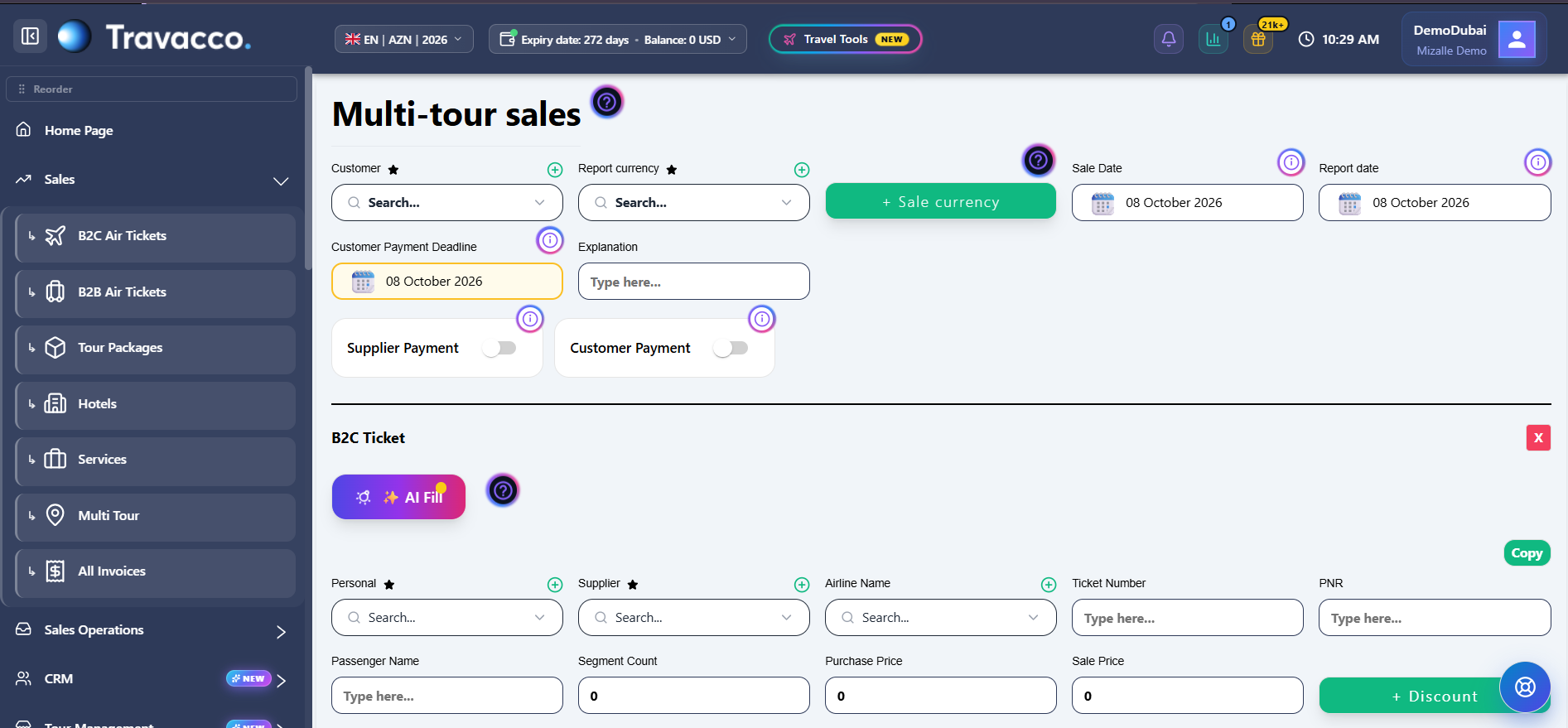
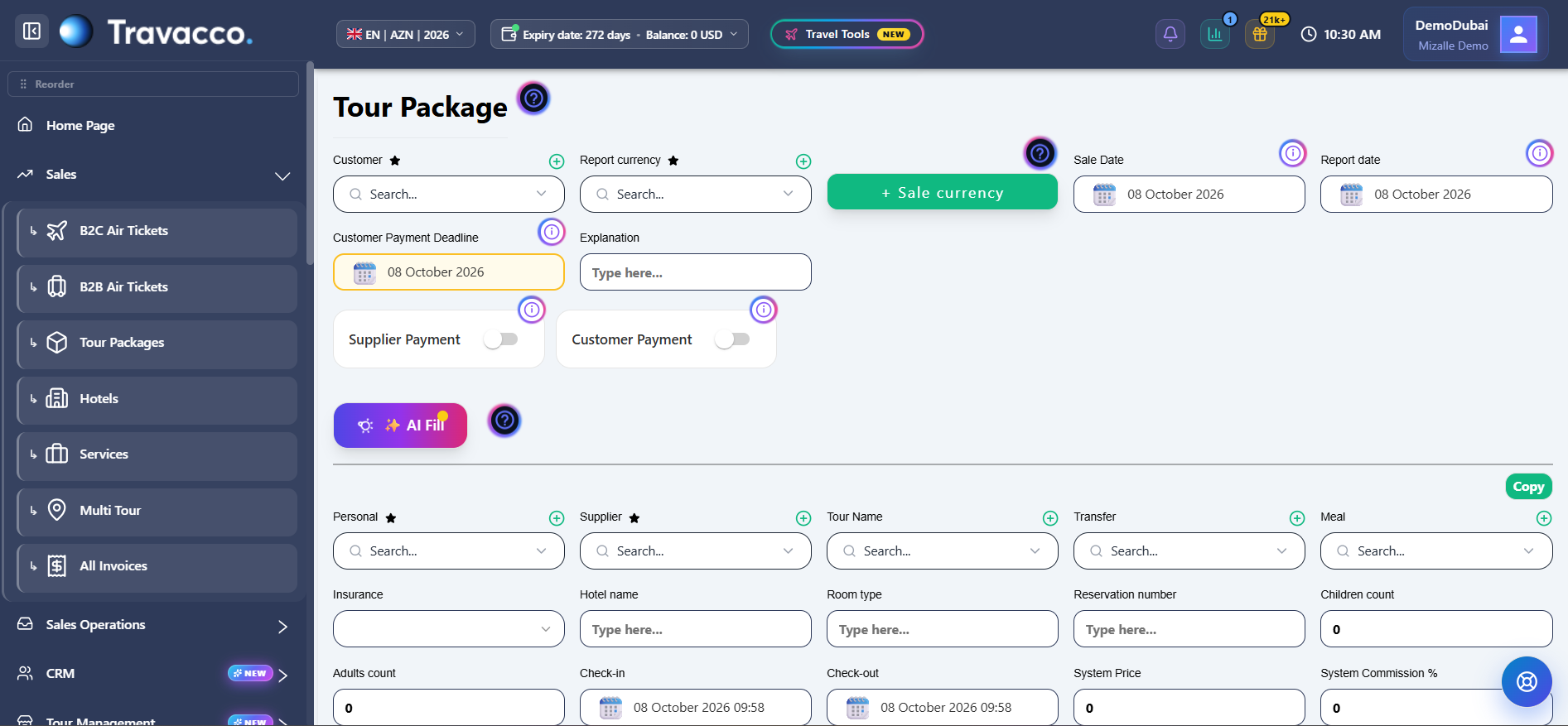
In a centralized system such as Travacco, Tour Package sales can be created with customer, supplier, hotel, reservation, amount, payment, commission, and voucher information.
So while the customer sees one package, the agency may be managing several connected pieces of information.
What Is a Multi-Tour?
A Multi-Tour is designed for a more complex travel journey, usually involving multiple destinations or multiple travel components within one trip.
Imagine a customer wants to travel:
Baku → Istanbul → Rome → Paris → Baku
They may stay in different hotels, take multiple flights, and have different services at different stages of the journey.
This is not simply one hotel and one return flight.
It is a journey made up of several connected travel elements.
A Multi-Tour structure is particularly useful when a single customer trip contains multiple flight segments, hotel reservations, and other components that need to be managed together.
For example:
Destination 1: Istanbul
- Flight from Baku
- 2 nights in a hotel
Destination 2: Rome
- Flight from Istanbul
- 3 nights in a hotel
Destination 3: Paris
- Flight from Rome
- 3 nights in a hotel
Return
- Flight from Paris to Baku
For the customer, this is one journey.
For the travel agency, it is a much more complex operation.
That is exactly why the distinction between a standard Tour Package and a Multi-Tour matters.
Multi-Tour vs Tour Package: The Main Difference
The easiest way to understand the difference is to think about structure.
A Tour Package generally focuses on selling a predefined combination of travel services as one package.
A Multi-Tour focuses more on managing a trip that can contain multiple destinations, routes, flights, hotels, and travel components.
Here is a simple comparison:
| Feature | Tour Package | Multi-Tour |
|---|---|---|
| Main purpose | Complete packaged trip | Multi-component journey |
| Destinations | Usually one main destination | Multiple destinations |
| Flights | Can be included | Can include multiple segments |
| Hotels | Can be included | Multiple hotels can be part of the journey |
| Structure | Package-based | Journey-based |
| Complexity | Usually simpler | Usually more complex |
| Best for | Standard holiday packages | Multi-destination trips |
The important point is that one is not necessarily better than the other.
They are designed for different types of travel products.
When Should a Travel Agency Use a Tour Package?
Tour Packages are a strong choice when the agency is selling a clearly defined travel product.
For example:
“7 Days in Antalya – Hotel + Flight + Transfer”
The agency already knows the main services included in the product.
This model can work especially well for:
- Beach holidays
- City breaks
- Resort holidays
- Seasonal packages
- Family holidays
- Group tours
- Hotel + flight combinations
- Promotional travel packages
The customer usually wants a straightforward answer:
What is included, how much does it cost, and when can I travel?
A package makes that offer easy to communicate.
From an operational perspective, the agency can also manage the sale through a structured package workflow, including hotel information, reservation details, payment data, commissions, and vouchers.
When Is Multi-Tour a Better Choice?
Now imagine the customer says:
“I don't want to stay in one city. I want to see three European cities in eight days.”
Suddenly, the booking becomes more complicated.
There may be:
- Multiple flights
- Multiple hotels
- Different check-in and check-out dates
- Several suppliers
- Different service costs
- Multiple booking references
- Different payment conditions
This is where a Multi-Tour structure becomes much more useful.
A Multi-Tour allows the agency to think about the customer's trip as one connected journey rather than treating every service as an unrelated sale.
For agencies selling customized itineraries, multi-destination holidays, complex business trips, or long journeys involving several stops, this structure can make the sales process much easier to organize.
The Difference Is Also Important for Profitability
There is another reason travel agencies need to distinguish between different sales types:
Profitability.
A trip might look profitable at first glance, but once the agency considers hotel costs, flight costs, supplier charges, commissions, refunds, and other expenses, the actual margin can be very different.
For a Multi-Tour, this can become even more important because the booking may contain several services.
Consider a simple example.
A customer pays $4,000 for a multi-destination trip.
The agency's costs include:
- Flights: $1,500
- Hotels: $1,600
- Transfers and other services: $400
Total cost:
$3,500
The agency's gross profit is:
$4,000 − $3,500 = $500
Without centralized financial visibility, it can be difficult to understand where that $500 came from and which part of the trip generated the margin.
A travel management system should therefore connect sales data with financial analysis.
Travacco's Profits report separates sales by type, including Tour Packages and Multi Tour, and provides purchase price, selling price, and profit information. It can also drill down into individual transactions.
That gives managers a much clearer picture of which travel products are actually contributing to the business.
What About Flights and Hotels?
This is another area where the distinction becomes practical.
A Multi-Tour may contain several flight segments and hotel reservations.
Instead of having this information scattered across different records, the agency benefits from having it connected to the same customer journey.
Travacco's reporting structure brings hotel reservations from different sales sources together, including Tour Packages and Multi Tour sales.
Flight reporting also includes tickets created through different sales channels, including Multi Tour, allowing agencies to analyze flight sales, suppliers, airlines, purchase prices, and selling prices from a centralized report.
This becomes particularly valuable as an agency grows.
With a small number of bookings, spreadsheets and separate notes might seem manageable.
With hundreds or thousands of transactions, they quickly become a source of duplicated data, missed information, and financial confusion.
Multi-Tour Is Not Just “A Bigger Package”
This is perhaps the most important distinction.
It is tempting to think:
Tour Package = small trip
Multi-Tour = bigger package
But that is not really the point.
The difference is about the structure of the journey.
A €5,000 single-destination luxury holiday can still be a Tour Package.
A €1,500 trip covering three cities can be a Multi-Tour.
The number of destinations, services, and travel segments changes how the journey needs to be organized.
In other words:
Tour Package is about packaging travel services.
Multi-Tour is about connecting multiple parts of a journey.
That distinction is much more useful for travel agencies when deciding how to organize their sales operations.
Why Centralized Management Matters
Regardless of which model an agency uses, the real challenge begins after the sale.
- Someone has to manage the customer.
- Someone has to track payments.
- Someone has to communicate with suppliers.
- Someone has to check hotel reservations.
- Someone has to prepare documents.
- Someone has to monitor outstanding balances.
- And eventually, someone needs to answer the most important management question:
Did we actually make money from this booking?
When these processes are managed separately, employees spend more time searching for information and reconciling records.
A centralized travel agency management system can connect these operations.
With Travacco, Tour Package and Multi-Tour sales can be managed alongside customer, supplier, hotel, flight, payment, contract, and reporting data. Tour Package details can also be used to generate invoices and agreements, while financial reports provide visibility into sales and profitability.
This means the agency can move from simply selling trips to actually managing the business behind those trips.
Which One Should Your Travel Agency Use?
There is no universal answer.
Choose a Tour Package when the travel product is relatively structured and can be sold as a predefined combination of services.
Choose a Multi-Tour when the customer journey includes multiple destinations, flight segments, hotels, or other connected travel services that need to be managed as one trip.
And if your agency sells both?
Then your system should support both.
Modern travel agencies rarely sell only one type of product. One customer may want a simple beach holiday, while another may request a customized multi-country itinerary.
The important thing is not forcing every booking into the same structure.
It is having the right structure for the right journey.
To
ur Packages and Multi-Tours may look similar from the outside: both involve customers, bookings, hotels, flights, payments, and travel services.
But behind the scenes, they solve different problems.
A Tour Package organizes a set of travel services into a complete product.
A Multi-Tour organizes multiple parts of a journey into one connected travel experience.
For travel agencies, understanding this difference can improve not only sales operations, but also booking management, financial control, supplier coordination, and profitability analysis.
And as the number and complexity of bookings grow, having these processes connected becomes increasingly important.
With a centralized platform such as Travacco, agencies can manage different sales types while keeping operational and financial information connected—helping teams spend less time searching for booking details and more time delivering better travel experiences.