
Your Invoice Should Look Like Your Business, Not Everyone Else’s
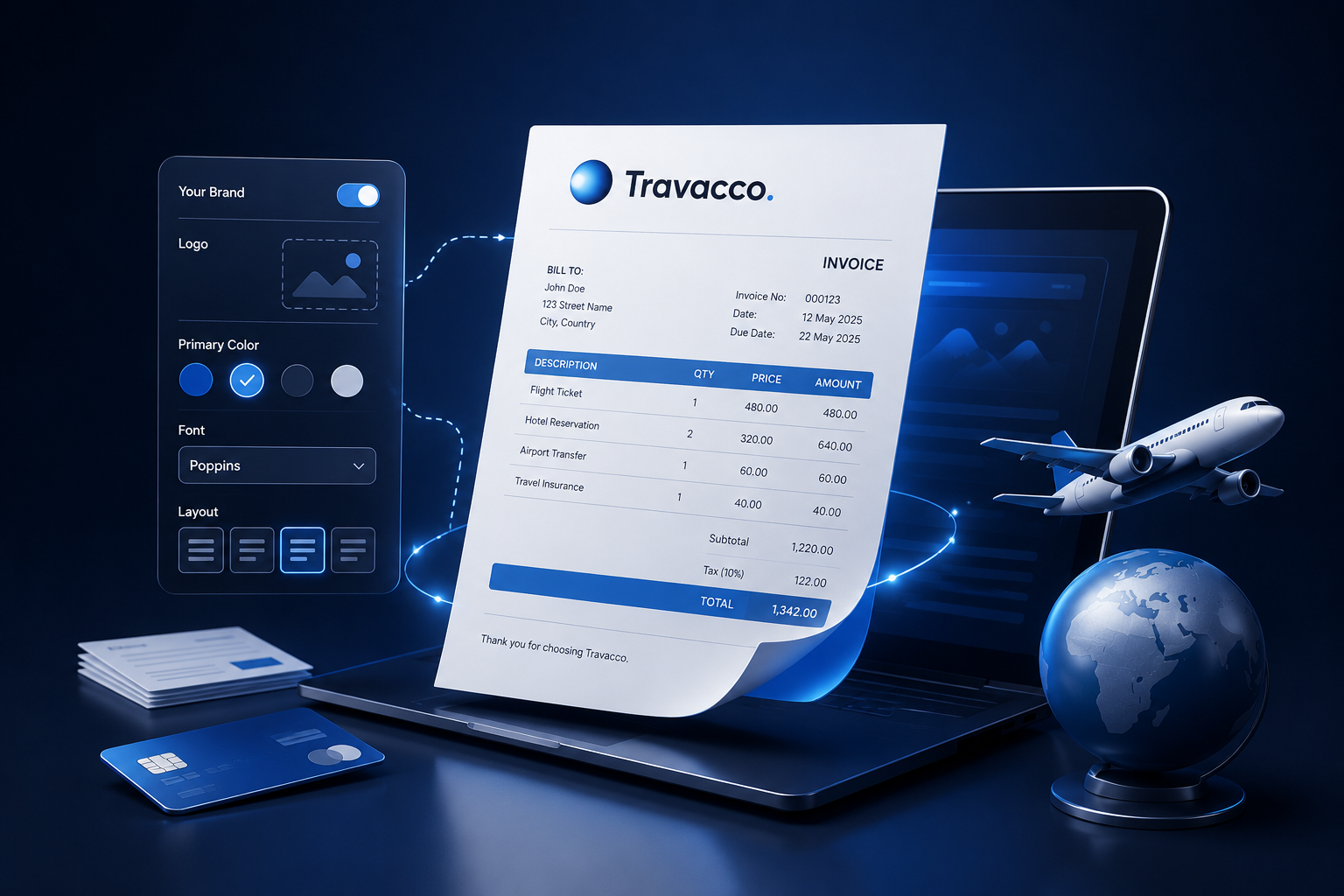
In the travel industry, an invoice is often treated as the final administrative step of a sale. A booking is confirmed, the payment details are recorded, and an invoice is generated and sent to the customer.
But from the customer’s perspective, an invoice is much more than a financial document.
It is another point of contact with your company.
It carries your business name, communicates important payment information, reflects how organized your operations are, and contributes to the overall impression customers have of your brand.
That is why sending the same generic-looking invoice as every other company is no longer enough.
Travel businesses operate differently. They work with different markets, currencies, services, suppliers, customers, payment structures, and internal processes. Their documents should be able to reflect those differences.
With customizable invoices in Travacco, travel companies can create invoice formats that better match the way they operate and the way they want their business to be presented.
Instead of adapting your company to a fixed invoice template, you can make the invoice adapt to your business.
An Invoice Is Part of the Customer Experience
Customer experience does not end once a traveler confirms a booking.
Every interaction that follows matters.
The confirmation message matters.
The payment process matters.
The voucher matters.
The itinerary matters.
And the invoice matters too.
Imagine a customer books a premium holiday package through a professional travel company. Throughout the sales process, the agency provides clear communication, structured information, and personalized service.
Then the customer receives an invoice that looks completely generic, contains poorly organized information, or does not match the company’s professional image.
The experience suddenly feels inconsistent.
This may appear like a minor detail, but customers often judge a company through these small touchpoints.
A well-structured and professionally presented invoice communicates something important without saying it directly:
- This business is organized.
- This business pays attention to detail.
- This business operates professionally.
For companies competing in the travel industry, that impression has real value.
Why One Invoice Format Does Not Work for Every Travel Business
No two travel companies operate exactly the same way.
- A corporate travel agency may need invoices that clearly present business customer information and payment details.
- A leisure travel company may prefer documents that are simpler and easier for individual travelers to understand.
- A destination management company may work with multiple services inside a single booking.
- A tour operator may need to present packages, transfers, hotels, tours, or other services in a structured format.
Companies also operate across different countries and markets, where document expectations can vary.
Yet many traditional systems force every company to work with the same predefined document structure.
The result is often a compromise.
Businesses either accept a document that does not fully represent their workflow or spend additional time manually modifying invoices outside the system.
Both approaches create unnecessary work.
Customization changes this.
Instead of forcing different businesses into one standard format, Travacco allows companies to create invoices that are more closely aligned with their own operational and communication requirements.
Your Business Has an Identity. Your Documents Should Have One Too.
Branding is often associated with websites, social media, advertisements, logos, and office design.
But branding also appears in operational documents.
When a customer receives an invoice, they should immediately recognize which company it belongs to.
Consistency across customer-facing documents creates a more professional experience and strengthens brand recognition.
This becomes especially important for growing travel companies.
As the number of customers increases, employees may generate dozens or even hundreds of documents. Without a standardized system, invoice formats can become inconsistent.
One employee may use one structure.
Another may use a different file.
Someone may accidentally send an outdated template.
Another employee may forget to include important information.
Over time, these small inconsistencies can make the company appear less organized.
A customizable invoice structure within a centralized platform helps create a more consistent document experience.
Instead of employees manually designing or editing every invoice, the company can establish the format that represents its business and use it throughout its operations.
Customization Is Not Just About Appearance
When people hear the word “customization,” they often think only about design.
But effective invoice customization is also about information.
An invoice should help the customer understand the transaction quickly.
- What service was purchased?
- What amount should be paid?
- What has already been paid?
- What company issued the document?
- What information is important for this particular transaction?
If customers struggle to understand an invoice, they may contact the company again for clarification.
That creates additional work for employees.
A clearer document can reduce unnecessary communication.
This is why invoice customization should not be viewed simply as a visual feature.
It is also an operational feature.
The ability to adapt invoice content and structure helps businesses communicate financial information in a way that is more suitable for their customers and their own processes.
From Generic Documents to Professional Communication
Travel companies communicate with customers through many different channels.
- WhatsApp.
- Email.
- Phone calls.
- Customer portals.
- Contracts.
- Vouchers.
- Invoices.
When these channels are disconnected, the customer experience can feel fragmented.
A modern travel management system should help companies create consistency across these interactions.
Travacco is designed around this idea of centralized management.
Instead of managing sales in one place, customers somewhere else, payments in spreadsheets, and documents in separate files, businesses can bring their operational processes together.
Customizable invoices become another part of that connected environment.
The invoice is no longer an isolated file created after a transaction.
It becomes part of the customer, sales, and financial workflow.
That connection is important because document management becomes easier when information already exists inside the same system.
Employees spend less time switching between tools and more time managing the actual customer relationship.
Reduce Manual Work Behind Every Invoice
Manual document editing may not feel like a major problem when a company has only a few bookings.
But as sales volume increases, repetitive administrative work grows quickly.
Suppose an employee needs only five minutes to adjust an invoice manually.
With ten invoices, that becomes fifty minutes.
With one hundred invoices, that becomes more than eight hours of repetitive work.
And the problem is not only time.
Manual editing creates opportunities for mistakes.
Incorrect formatting.
Old company information.
Missing details.
Copy-paste errors.
Different document versions.
These problems become harder to control as a business expands.
By creating an invoice format that fits the company’s requirements inside Travacco, businesses can reduce the need for repeated manual adjustments.
The objective is simple: configure the document once and make the workflow more consistent afterward.
Automation becomes valuable when it removes small repetitive tasks that employees should not have to perform again and again.
Better Documents Support Better Operations
Professional documentation also improves internal processes.
When invoice structures are consistent, employees know what information customers will receive.
Sales teams can communicate more confidently.
Finance teams can work with clearer documentation.
Managers can establish company-wide standards instead of relying on individual employee habits.
New employees also adapt more quickly because they do not need to learn several different manual invoice templates.
This becomes increasingly valuable as companies grow.
Growth creates complexity.
- More customers.
- More employees.
- More transactions.
- More documents.
More opportunities for information to become inconsistent.
The solution is not simply to work harder.
The solution is to create systems that allow the company to handle more activity without losing control.
Customizable invoices are a small but meaningful part of that broader operational structure.
Adapt Your Documents to Different Customer Expectations
Travel is an international business.
Even companies operating from a single country may work with customers, suppliers, or partners from multiple markets.
Customer expectations can differ significantly.
Some customers prefer detailed financial documents.
Others want simple and direct information.
Corporate clients may expect a different level of documentation from individual travelers.
Companies may also communicate in different languages or operate with different document standards.
A rigid invoice structure makes this flexibility difficult.
A customizable approach gives travel businesses greater control over how their documents are presented.
This becomes especially useful for agencies expanding into new customer segments or international markets.
As the company evolves, its documents can evolve with it.
The system should not become an obstacle to growth.
It should support it.
Small Details Influence Trust
Trust is essential in travel.
Customers often pay significant amounts of money before receiving the final service.
They may be booking flights, hotels, tours, transfers, or entire travel packages weeks or months in advance.
Because of this, every professional detail contributes to confidence.
A clear invoice may seem insignificant compared with the actual trip, but it represents the company during an important financial interaction.
Customers want to know that their payment is being handled professionally.
- They want clear documentation.
- They want transparency.
- They want to feel that the company managing their trip is organized.
Professional documents help reinforce that confidence.
The same principle applies in B2B relationships.
Corporate customers, suppliers, and partners often evaluate professionalism through operational processes, not advertising.
A company may have an excellent website, but if its financial documentation is inconsistent, the overall impression changes.
Strong operations protect strong branding.
Your Invoice Should Work for Your Business
Technology should adapt to business processes, not force every business into exactly the same workflow.
That principle becomes increasingly important as travel companies move from manual processes toward centralized digital management.
Companies need systems that provide structure without removing flexibility.
Customizable invoices in Travacco support that balance.
Businesses can maintain a structured invoice workflow while adapting the document to their own identity and operational requirements.
Instead of asking:
“How do we change our process to fit this template?”
The better question becomes:
“How should our invoice work for our company?”
That shift gives businesses greater control over one of the most common documents in their financial operations.
One Platform, More Control
Invoice customization becomes even more useful when it is connected to the wider business environment.
Travel companies do not need another standalone invoice tool.
They need their documents to work together with their sales, customers, payments, financial records, and operational processes.
That is where centralized management creates real value.
Travacco brings different parts of travel business management into one platform, helping companies reduce fragmented workflows and maintain greater control over daily operations.
Customizable invoices extend that flexibility to customer-facing financial documents.
The goal is not simply to make invoices look better.
The goal is to make them work better.
- Better for the company.
- Better for employees.
- Better for customers.
And better for a travel business that wants to operate professionally as it grows.
An invoice may be one of the most familiar documents in any travel business, but familiar does not mean unimportant.
- It represents a financial transaction.
- It communicates with the customer.
- It reflects the company’s professionalism.
And in many cases, it becomes part of the customer’s permanent record of their experience with the business.
That is why travel companies should have more control over how invoices are created and presented.
With customizable invoices in Travacco, businesses can move away from generic document structures and create invoices that better reflect their own operations, communication style, and professional identity.
Because your customers are not dealing with a generic travel company.
They are dealing with your company.
Your documents should make that clear.