
How Travel Agencies Handle Thousands of Customer Requests

The modern tourism business operates at an unprecedented speed. With global travel becoming more accessible and digital platforms simplifying the booking process, travel agencies now handle an enormous volume of customer requests every day. These requests range from simple flight inquiries to complex, multi-destination travel arrangements involving hotels, transportation, visa processing, insurance, and special customer requirements.
At first glance, it may seem that managing travel requests is straightforward: a customer asks for a trip, and the agency books it. However, in reality, each request triggers a complex operational chain that involves multiple departments, systems, and external partners. As the volume of requests increases, the complexity multiplies, requiring structured systems and efficient coordination to ensure accuracy and speed.
In today’s competitive tourism environment, handling thousands of customer requests is not just about working harder—it is about working smarter. Travel agencies must ensure fast response times, accurate bookings, seamless communication, and error-free execution while maintaining high customer satisfaction. This is where modern travel management solutions, such as Travacco, become essential for sustainable operations.
Travacco represents a new generation of centralized travel management platforms designed to help agencies streamline operations, reduce manual workload, and efficiently manage large volumes of customer interactions. Integrating multiple operational processes into a single system enables travel agencies to transform complexity into structured efficiency.
The Growing Volume of Customer Requests in Tourism
The tourism industry has experienced significant growth due to digital transformation, online booking platforms, and increased global mobility. Customers today expect instant responses, personalized offers, and real-time updates on their travel plans.
As a result, travel agencies are no longer dealing with a few requests per day. Instead, they often handle hundreds or even thousands of inquiries simultaneously. These include:
- Flight bookings and ticket changes
- Hotel reservations and modifications
- Visa applications and documentation
- Tour package customization
- Group travel arrangements
- Payment confirmations and invoices
- Cancellation and refund requests
- Emergency travel support
Each of these requests requires attention to detail, coordination with suppliers, and timely communication with the customer. Without a structured system, managing such volume becomes overwhelming.
The Complexity Behind a Single Request
To understand how travel agencies manage thousands of requests, it is important to break down what happens behind a single customer inquiry.
A simple travel request often involves multiple steps:
- Understanding customer requirements
- Checking availability across airlines, hotels, and suppliers
- Comparing prices and options
- Coordinating with external partners
- Creating and confirming bookings
- Generating invoices and payment tracking
- Preparing travel documents
- Communicating updates to the customer
Each step involves different tools, systems, and departments. When multiplied by thousands of requests, the operational workload becomes extremely complex.
This complexity highlights why manual workflows are no longer sufficient in modern tourism operations.
Challenges Travel Agencies Face in High-Volume Operations
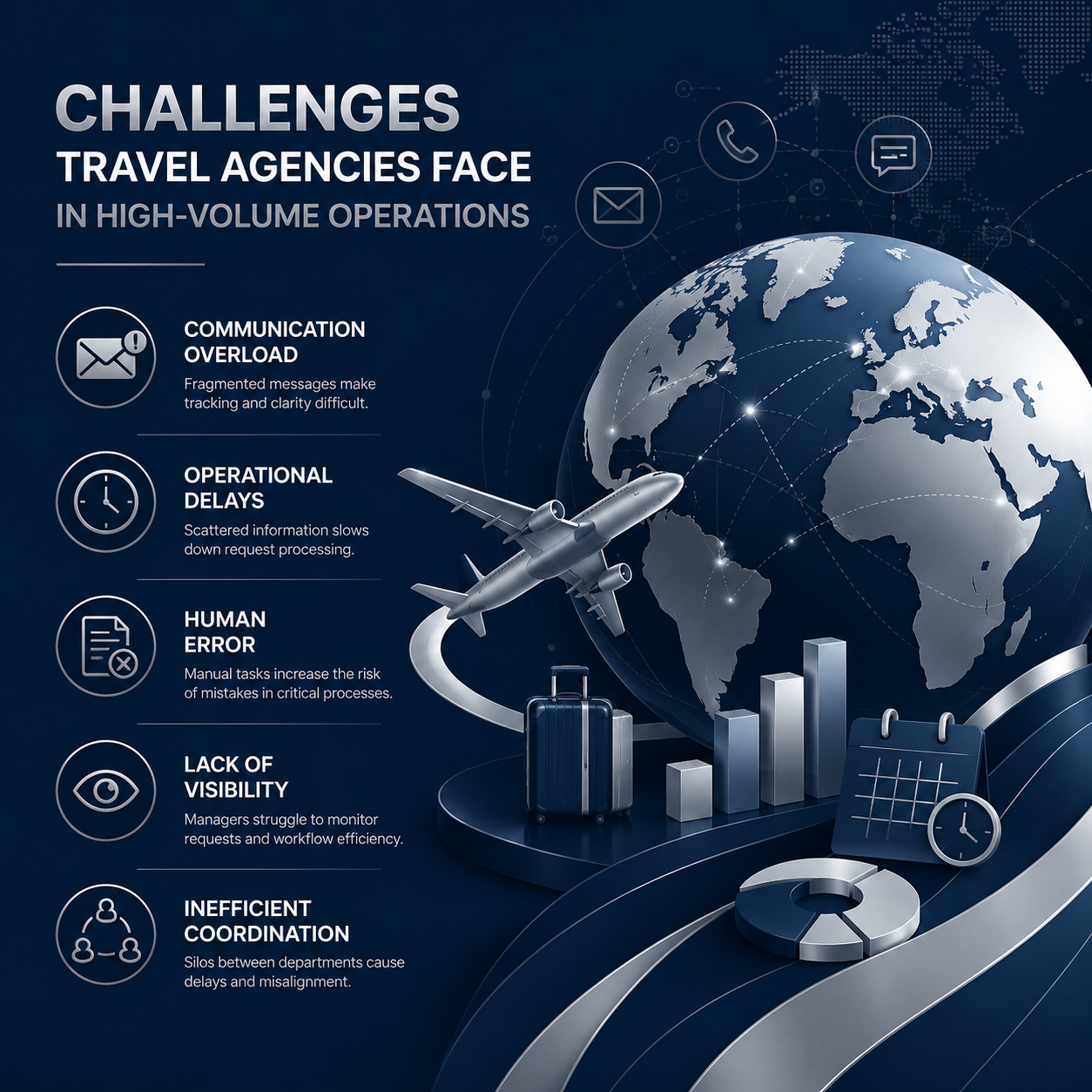
Handling large numbers of customer requests introduces several operational challenges that directly affect efficiency and service quality.
1. Communication Overload
Travel agencies rely heavily on emails, messages, and phone calls. With thousands of requests, communication becomes fragmented, making it difficult to track updates and maintain clarity.
2. Operational Delays
When information is scattered across different systems, employees spend significant time searching for data instead of processing requests.
3. Human Error
Manual data entry and repetitive tasks increase the risk of mistakes in bookings, invoices, and customer information.
4. Lack of Visibility
Without centralized systems, managers struggle to monitor the status of ongoing requests and overall workflow performance.
5. Inefficient Coordination
Different departments often work in silos, leading to delays and misalignment between sales, operations, and finance teams.
These challenges highlight the need for a more structured and integrated approach to travel management.
The Role of Technology in Managing Customer Requests
Technology has become a core element in modern tourism operations. It allows travel agencies to automate repetitive tasks, centralize data, and improve communication between departments.
Instead of relying on disconnected tools, agencies now require platforms that unify all operational processes into a single ecosystem.
This is where digital transformation plays a critical role. By implementing advanced travel management systems, agencies can significantly improve efficiency, reduce operational pressure, and handle large volumes of requests more effectively.
Among these solutions, Travacco stands out as a centralized platform designed specifically for travel agencies dealing with high operational complexity.
How Travacco Helps Travel Agencies Handle Thousands of Requests
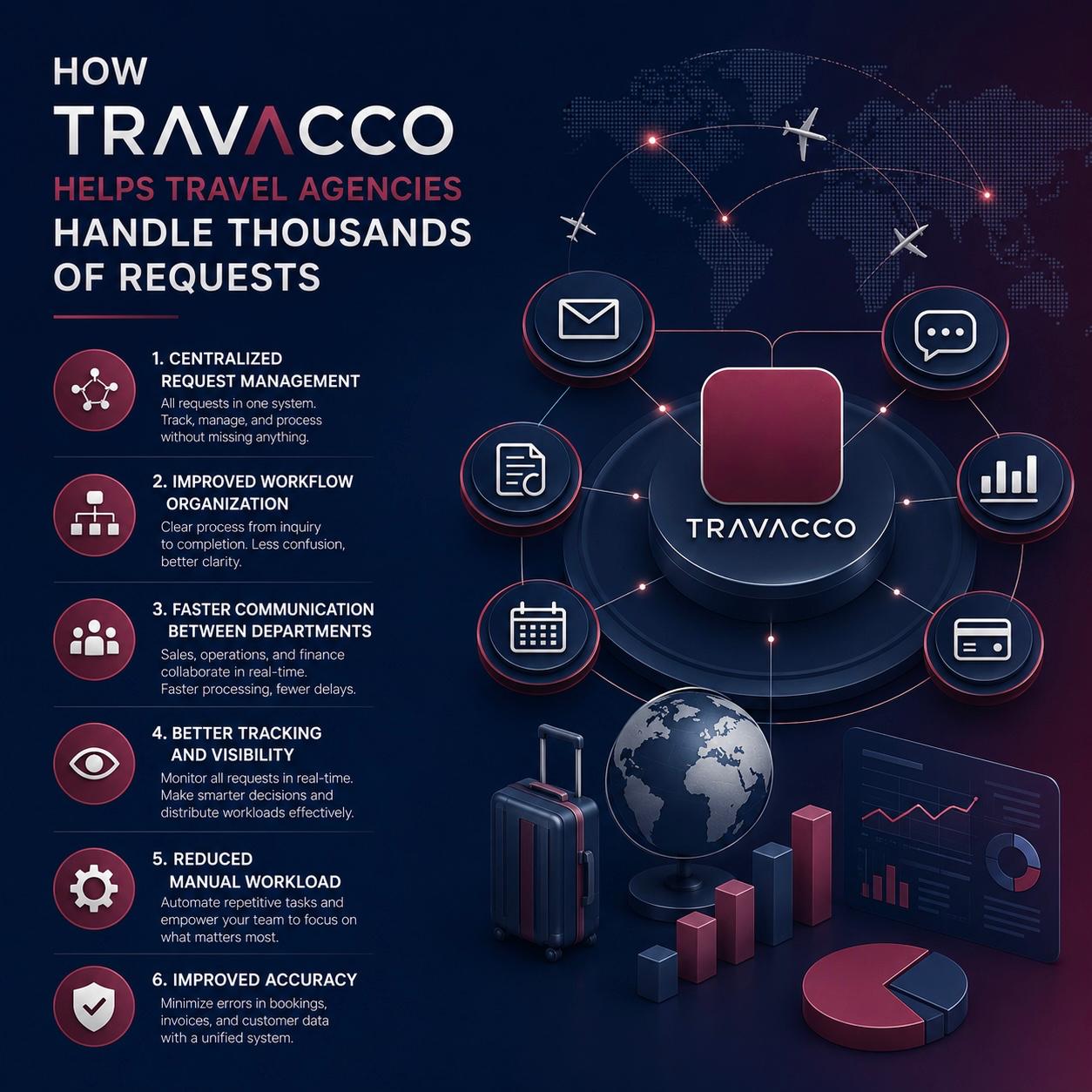
Travacco is designed to simplify and optimize the entire workflow of travel agencies. Instead of managing fragmented systems and manual processes, agencies can use a unified platform to handle operations more efficiently.
1. Centralized Request Management
One of the most important features of Travacco is its ability to centralize all customer requests in one system. This allows teams to track, manage, and process inquiries without losing information across multiple channels.
2. Improved Workflow Organization
Travacco helps agencies structure their workflows more effectively. Each request follows a clear process from inquiry to completion, reducing confusion and improving operational clarity.
3. Faster Communication Between Departments
With all information available in one place, departments such as sales, operations, and finance can collaborate more efficiently. This reduces delays and ensures that customer requests are processed faster.
4. Better Tracking and Visibility
Managers can easily monitor the status of all ongoing requests. This visibility allows for better decision-making and improved workload distribution across teams.
5. Reduced Manual Workload
By minimizing repetitive manual tasks, Travacco allows employees to focus on more important responsibilities such as customer service and problem-solving.
6. Improved Accuracy
Centralized systems reduce the risk of errors in bookings, invoices, and customer data, ensuring more reliable operations.
Through these improvements, Travacco enables travel agencies to scale their operations without sacrificing quality or efficiency.
The Impact on Customer Experience
While Travacco primarily improves internal operations, its most significant impact is on customer experience.
When travel agencies manage requests efficiently, customers benefit from:
- faster response times
- accurate travel information
- smoother booking processes
- fewer delays and errors
- more professional communication
In the tourism industry, customer satisfaction is directly influenced by operational performance. A well-organized backend system ensures that customers receive timely and reliable service at every stage of their journey.
By using Travacco, agencies are able to maintain consistency and quality even when handling thousands of requests simultaneously.
Scaling Without Losing Control
One of the biggest challenges for growing travel agencies is scalability. As the number of customers increases, maintaining operational control becomes more difficult.
Without proper systems, growth often leads to:
- operational confusion
- slower processes
- reduced service quality
However, with centralized platforms like Travacco, agencies can scale more effectively. They can handle increased demand without losing visibility, structure, or efficiency.
This ability to scale is essential in today’s competitive tourism market, where speed and accuracy determine business success.
Handling thousands of customer requests is one of the most complex challenges in the modern tourism industry. Behind every simple travel inquiry lies a network of operational processes that require coordination, accuracy, and speed.
Traditional manual methods are no longer sufficient to manage this level of complexity. As travel agencies grow, they need structured systems that can support large-scale operations while maintaining efficiency and quality.
Platforms like Travacco provide a modern solution to this challenge by centralizing operations, improving workflow management, and enabling better coordination across departments.
Ultimately, the success of a travel agency is no longer determined only by the destinations it offers, but by how effectively it manages the thousands of customer requests behind those experiences. In this evolving industry, operational intelligence has become just as important as customer service—and tools like Travacco are helping shape the future of tourism management.